Green claims you can prove.
Findings and the scan report
A finding names one environmental claim found on your page, the EU rule it corresponds to, quoted in its dated version, why the claim matches it and the direction to fix it. The scan report ranks the findings by severity; it is dated and carries its fingerprint.
Keep selling green, with the proof to back it.
Since 27 September 2026, every environmental claim must be provable, in all twenty-seven member states. ClaimTrace tells you, page by page, what you can keep saying, what needs proof and what needs rewording, then keeps dated evidence of every decision.
For marketing, legal and sustainability teams of brands, retailers and service providers addressing consumers in the EU.
EU rules, plus the national rules of France and Germany today; other member states follow.
Illustrative example, based on real calibration cases (wording translated).
A finding within 90 minutes.
You give us an address
Up to five addresses from your own domain, one market, no payment card.
The Detector runs
Every claim is isolated, tied to the applicable rule in its version, and classified.
You receive a dated report
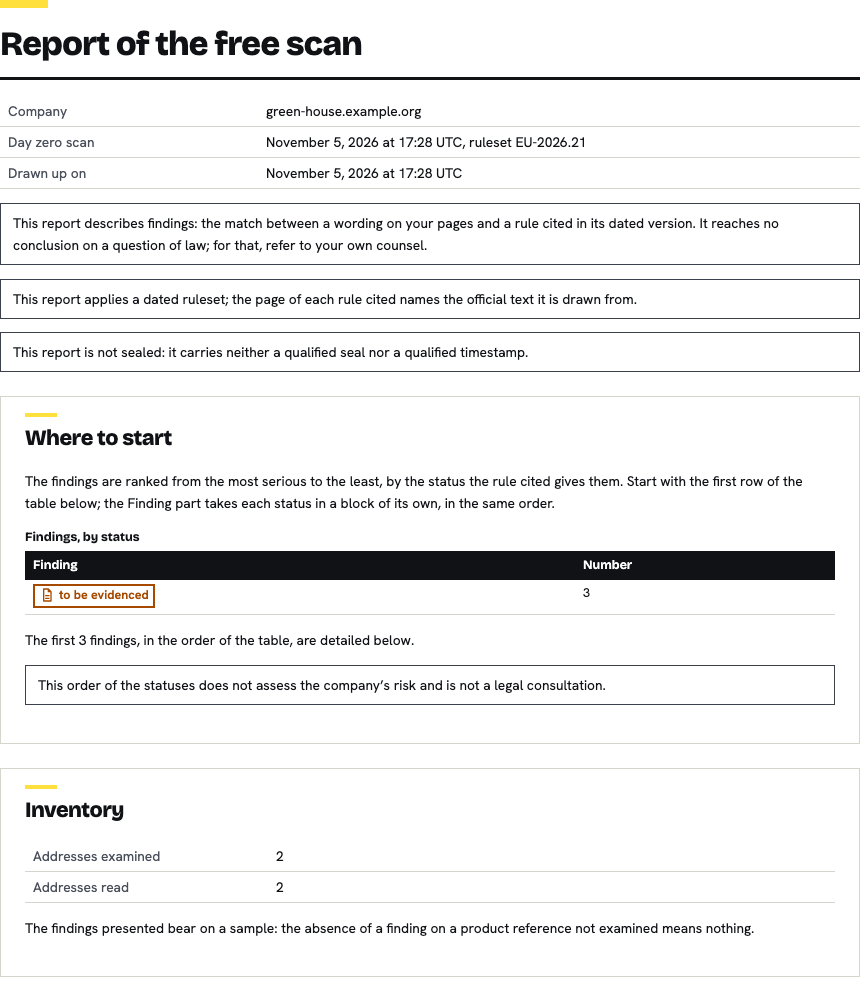
A dated PDF, with its hashes, arrives by email within 90 minutes. It is yours, whether you subscribe or not.
The free scan is open: run the free scan on five addresses of your domain.
A dated report, claim by claim.
| Claim | Status | Rule cited | What it calls for |
|---|---|---|---|
| “ecological and respectful of the environment” | matches a prohibited practice | Directive (EU) 2024/825, Annex I, point 4a | To handle without delay: removal or rewriting to be considered, with your legal adviser. |
| “55% recycled plastic” | to be evidenced | Directive 2005/29/EC, as amended by Directive (EU) 2024/825 | Attach the supporting document to the claim. |
| “recyclable packaging” | to be specified | Directive 2005/29/EC, as amended by Directive (EU) 2024/825 | State the scope, the perimeter and the method. |
The rulebook version and the date are recorded with every finding. Illustrative example.
Four public statuses, in plain words.
The register carries a full canonical vocabulary; reports sent to your teams and public pages use the four labels below, chosen to be understood without a glossary.
| Status | What it means | What it calls for |
|---|---|---|
| matches a prohibited practice | The wording matches a practice on a prohibition list in the text (rule cited, dated version), whatever evidence is held. What follows is for you and your counsel to decide. | To handle without delay: removal or rewriting to be considered. |
| falls under a cited rule, to be assessed case by case | The wording falls under a rule applied case by case (rule cited, dated version); the page does not show what this rule asks for. | A person assesses the case: rewriting to be considered, decision documented. |
| to be specified | The claim is too generic to be assessed: its scope is not stated. | State the scope, the perimeter and the method. |
| to be evidenced | The claim can be supported if the evidence exists, is current and covers the scope announced. | Attach the supporting document to the claim. |
No claim is marked “no action required” while the scope announced exceeds the perimeter of its evidence. That check is a product invariant, not a setting. And the machine never marks one so: only a person, on your side or ours, decides there is nothing to do, after reading the finding. When a prohibition applies without being the main rule, the finding still names it: none is set aside in silence.
You will confirm by a link sent by email, and can unsubscribe in one click. The form is loaded from Brevo, our email provider, only when you click.